|
from 10 march 2002 blue vol II, #24 |
|

 |
|
Epilogue from A Guide to the End of the World by Bill McGuire
 Pondering in isolation upon the consequences of global warming, the imminence of the next Ice Age, or the timing of a future super–eruption or asteroid impact can engender fleeting concern. Consideration en masse of the future threats to our planet and our race is quite capable, however, of contributing to bouts of severe depression. Let me summarize our current position. We are now well into a cycle of warming that is certain to lead to dramatic geophysical, social, and economic changes during the next hundred years that will impinge – probably largely detrimentally – on everyone. At the same time our planet is teetering on the edge of the next Ice Age, whose start global warming might actually bring forward, but which is likely to arrive within the next several thousand years even without our help.
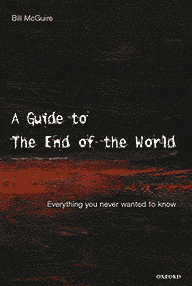
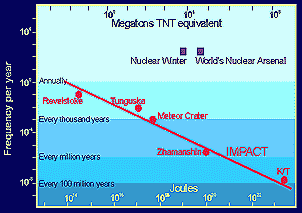
Hardcover jacket, Oxford University Press, 2002 Asteroids sufficiently large to wipe out a quarter of the human race continue to hurtle across the Earth's orbit undetected, while who knows when we will detect the next great comet coming our way. There are now so many of us that the next giant tsunamis or volcanic super–eruption cannot fail to result in millions of deaths and the enormous disruption of our so–called advanced global society. So interconnected is our social and economic framework that just a single quake in Japan could lead to global economic disaster. There are other trends too that will ensure an end to the world as we know it, and within this century. Although the world's population is still rising, the rate started to slow in 1968 and numbers will peak at around 9 billion – half as great again as today – in about 2070. After that they will begin to fall and will be down to 8. 4 billion just 30 years later. Welcome as this trend is, its legacy will be an ageing population and a so–called 'grey' future. By the end of the century an extraordinary 50 per cent or so of people in Japan and western Europe will be 60 or older, and a full third of the planet's population will be over this age. In a world where the elderly hold increasing sway over the young, some believe that intergenerational conflicts may come to dominate the political scene.
Probably the only piece of good news that can be taken away from my brief look at the end of the world as we know it is that although this is going to happen – and soon – the survival of our race seems to be assured, for now at least. Leaving aside the possibility of a major comet or asteroid impact on a scale of the dinosaur–killer 65 million years ago – which only happen every few hundred million years – it is highly unlikely that anything else is going to wipe out every single last one of us – all 6 billion plus – in the foreseeable future. Even the replacement of the world with which we have become so familiar with one of sweltering heat or bitter cold might not seem as scary for those of our descendants likely to be in the thick of things. After all, we are a remarkably adaptable species, and can change to match new circumstances with some aplomb. Familiar 'worlds' have certainly ended many times before, as no doubt a centenarian born and raised while Queen Victoria sat on the throne of the United Kingdom, and who lived to see man land on the moon, would testify. The danger is, however, that the world of our children and those that follow will be a world of struggle and strife with little prospect of, and perhaps little enthusiasm for, progress as the Victorians viewed it. Indeed, it would not be entirely surprising if, at some future time, as the great coastal cities sink beneath the waves or below sheets of ice, the general consensus did not hold that there had been quite enough progress thank you – at least for a while.
|
|||
 Not only will the future of our descendants be greyer, it will also be dull and barren. In one of the greatest mass extinctions ever, our activities are currently wiping out between 3, 000 and 30, 000 species a year, from an estimated total of just 10 million. Up to one–third of flowering plants could be at risk, while between 25 and 50 per cent of all animal species could disappear before the chimes ring in the new century on 1 January 2100. As more and more species are obliterated their places will quickly be taken by the pests, weeds, and diseases that live cheek–by–jowl with the human race. Instead of a world of gorillas, pandas, birds of paradise, and corals, our descendants will have to make do with rats, cockroaches, thistles, and nettles. Furthermore, biodiversity is such a fragile thing – tenderly and incrementally reared by evolution – that it may take 5 million years or more for it to restore itself. In the meantime, we will have committed an estimated 500 trillion of our descendants to life on a dull and – in terms of variety – largely lifeless planet. Just as importantly, we are actually playing God with evolution itself and the entire future prospects of life on Earth. By wiping out the bulk of species that exist today, we are destroying much of evolution's raw material and severely limiting the planet's ability to generate the species of the future. For millions of species throughout geological time the end of the world has already come, and our activities are ensuring that the same fate will shortly face many of the life forms with which we currently share our planet.
 While I have tried in these pages to extrapolate current trends and ideas to tease out and examine somewhat depressing scenarios for the future of our planet and our race, I am sure that, to some extent at least, you would be justified in accusing me of a failure of the imagination. After all, I have rarely looked ahead beyond a few tens of thousands of years, and yet our Sun will still be bathing our planet in its life–giving warmth for another 5 billion years or more. Who knows, over that incomprehensible length of time, what Homo sapiens and the species that evolve from us will do and become. Our species and those that follow may be knocked back time and time again in the short term, but provided we learn to nurture our environment rather than exploit it, both here on Earth – before the Sun eventually swallows it up – and later, perhaps, in the solar system and the galaxy and beyond, then we have the time to do and be almost anything. Maybe now is the right time to start.
|
BLUE is looking for short fiction, extracts of novels, poetry, lyrics,
polemics, opinions, eyewitness accounts, news, features, information and arts
in any form relating to eco cultural- social- spiritual issues, events and
activites (creative and political). Send to Newsdesk. |